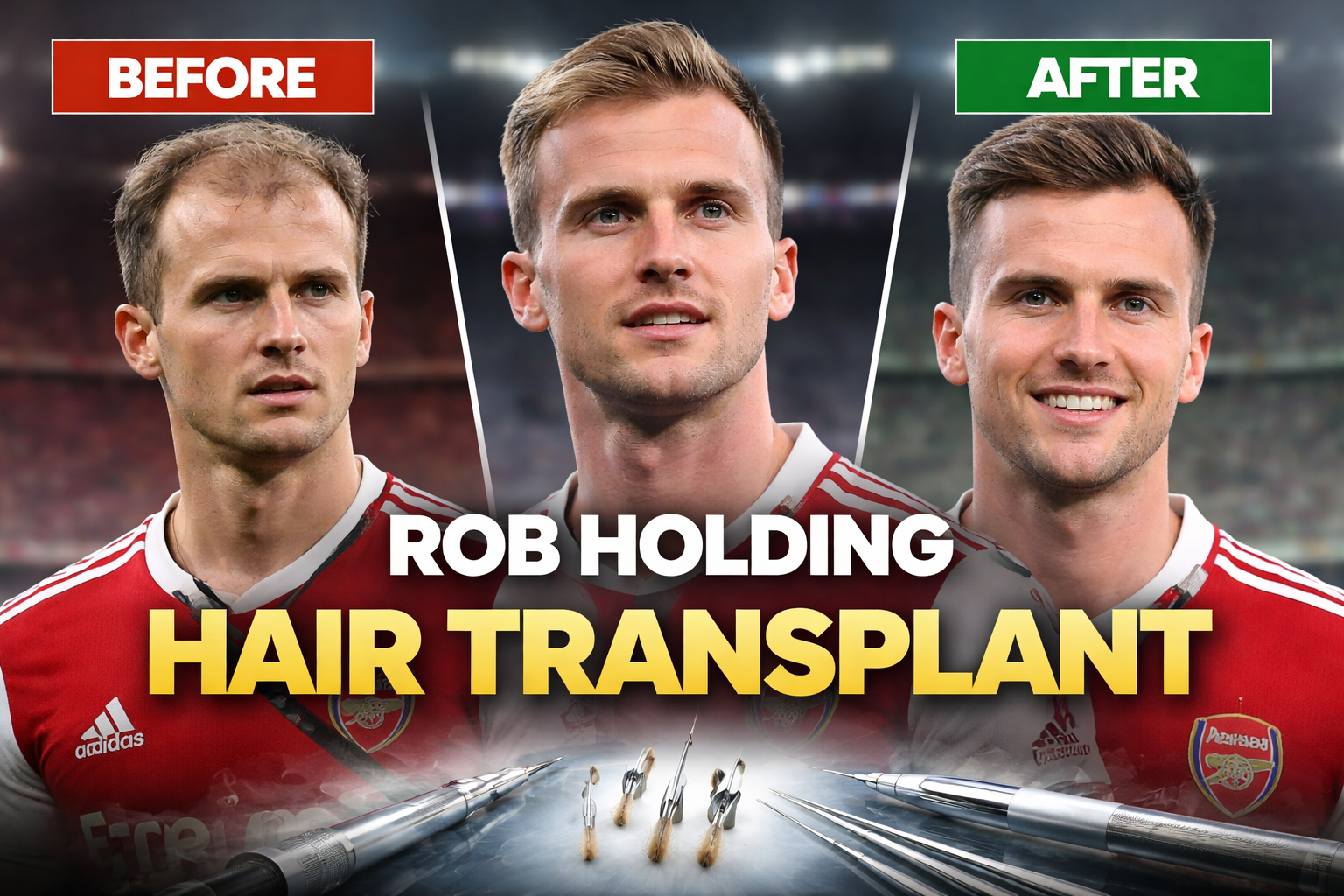
When discussing modern hair restoration success stories in professional sports, the transformation of Rob Holding stands out as one of the most visible and impactful cases. As a hair transplant specialist, I’ve analyzed hundreds of procedures across public figures, and Holding’s journey offers valuable insight into technique, timing, and realistic expectations.
This review breaks down his hair transplant from a clinical perspective—examining the likely methods used, the progression of his results, and what makes this case particularly noteworthy for patients considering similar treatment.
Background: Rob Holding’s Hair Loss Journey
Rob Holding, best known for his time at Arsenal FC, began showing signs of androgenetic alopecia (male pattern baldness) in his early-to-mid 20s. This is not unusual—genetic hair loss can begin at a relatively young age, especially in men with a strong family history.
By around 2018–2019, his hairline recession had become noticeable:
- Thinning at the temples
- Early Norwood Stage 2–3 pattern
- Reduced density at the frontal scalp
For a professional athlete constantly in the public eye, this type of hair loss often accelerates the decision to seek treatment.
The Hair Transplant Decision
Unlike many celebrities who remain discreet, Holding openly acknowledged undergoing a hair transplant. This transparency is important—it helps normalize medical hair restoration and sets realistic expectations.
From an expert standpoint, his decision was well-timed. He acted before extensive crown loss occurred, which offers several advantages:
- Higher graft survival rate
- Better donor-recipient balance
- More natural-looking outcomes
- Lower total graft requirement
Likely Technique Used: FUE Hair Transplant
Based on visual analysis and industry standards, Holding most likely underwent a Follicular Unit Extraction (FUE) procedure.
Why FUE Was the Logical Choice
FUE is the preferred method for high-profile individuals due to:
- Minimal scarring (no linear scar)
- Faster recovery time
- Ability to wear short hairstyles
- Precision in hairline design
In Holding’s case, the absence of visible scarring—even during close-up match footage—strongly supports the use of FUE.
Estimated Graft Count
From a professional evaluation of before-and-after images, Holding likely received:
1,800 to 2,500 grafts
This range would be sufficient to:
- Reconstruct the frontal hairline
- Add density to the frontal third
- Slightly reinforce mid-scalp density
This is considered a moderate procedure—not overly aggressive, but highly strategic.
Hairline Design: The Key to Natural Results
One of the most impressive aspects of Holding’s transplant is the hairline design.
Observations:
- Soft, irregular frontal edge (avoids “pluggy” look)
- Age-appropriate placement (not too low)
- Natural temple recession maintained
- Proper angulation of grafts
This indicates that the surgeon prioritized natural aesthetics over density alone, which is exactly what separates average results from elite ones.
Growth Timeline: What We Can Learn
Holding’s results followed a typical FUE growth pattern:
0–2 Months
- Shedding phase (“shock loss”)
- Transplanted hairs fall out temporarily
3–5 Months
- Early regrowth begins
- Fine, thin hairs visible
6–9 Months
- Significant improvement in density
- Hair begins to thicken
12+ Months
- Final result achieved
- Full density and texture maturation
His transformation became particularly noticeable around the 6–9 month mark, aligning perfectly with expected clinical timelines.
Density and Coverage: A Balanced Approach
Holding’s transplant did not aim for extreme density. Instead, it focused on:
- Strategic placement
- Visual fullness
- Long-term sustainability
This is crucial. Overpacking grafts in the frontal area can:
- Damage existing follicles
- Reduce blood supply
- Lead to unnatural results
His surgeon clearly avoided these pitfalls.
Donor Area Quality
A successful transplant depends heavily on the donor area (typically the back and sides of the scalp).
In Holding’s case:
- Donor density appears strong
- No visible over-harvesting
- Even distribution of extracted grafts
This suggests a conservative extraction strategy, which preserves options for future procedures if needed.
Why His Results Look So Natural
Several technical factors contribute to the natural appearance:
1. Proper Graft Placement
Single-hair grafts used at the hairline, multi-hair grafts behind.
2. Correct Angulation
Hair grows in the natural direction, not upright or artificial.
3. Density Gradient
Gradual increase in density from front to back.
4. Ethnic Hair Matching
His natural hair characteristics were respected—texture, curl, and thickness.
Psychological and Professional Impact
Hair restoration isn’t just cosmetic—it can significantly affect confidence.
For a footballer like Holding:
- Increased self-confidence on and off the pitch
- Reduced media scrutiny regarding appearance
- Enhanced personal branding
It’s worth noting that confidence often translates into performance. While not directly measurable, many patients report improved self-esteem post-procedure.
Cost Estimate of Rob Holding’s Procedure
While exact figures are not public, based on UK and European clinic standards:
- Estimated cost: £4,000 – £10,000
- Depends on clinic reputation, surgeon expertise, and graft count
Given the quality of the result, it’s likely he chose a reputable clinic rather than a budget option.
Comparison With Other Footballers
Holding’s transplant stands out because it avoids the common mistakes seen in some high-profile cases:
What He Did Right:
- Didn’t lower hairline excessively
- Chose natural density over artificial thickness
- Likely used a skilled, experienced surgeon
Many players opt for overly aggressive hairlines, which can look unnatural over time. Holding’s approach is more sustainable.
Maintenance and Long-Term Considerations
A hair transplant is not a cure for hair loss—it redistributes existing hair.
To maintain results, patients often use:
- Finasteride (to slow DHT-related loss)
- Minoxidil (to support growth)
- PRP therapy (optional)
While Holding hasn’t publicly detailed his regimen, maintaining surrounding native hair is essential for long-term success.
Potential Risks He Avoided
Every transplant carries risks, including:
- Overharvesting
- Poor graft survival
- Infection
- Unnatural hairline
The absence of these issues in Holding’s case highlights:
- Skilled surgical execution
- Proper aftercare
- Realistic expectations
Lessons for Patients Considering Hair Transplants
Holding’s journey offers several key takeaways:
1. Timing Matters
Early intervention leads to better outcomes.
2. Choose Natural Over Aggressive
A conservative hairline ages better.
3. Surgeon Skill Is Critical
Results depend more on technique than graft count.
4. Expect a Process, Not Instant Results
Full transformation takes 12 months or more.
Is His Result Replicable?
Yes—with the right conditions:
- Good donor area density
- Similar hair characteristics
- Early-stage hair loss
- Access to a skilled clinic
However, results vary based on individual factors such as:
- Genetics
- Hair thickness
- Scalp condition
Expert Verdict
From a professional standpoint, Rob Holding’s hair transplant can be classified as a high-quality, well-executed FUE procedure.
Strengths:
- Natural hairline design
- Balanced density
- No visible scarring
- Excellent growth progression
Minor Limitations:
- Not ultra-dense (by design)
- Requires ongoing maintenance
Overall rating: 9/10
Final Thoughts
Rob Holding’s hair transplant is a textbook example of how modern hair restoration should be approached. It demonstrates that the best results are not always the most dramatic—but the most natural.
For individuals in the UK considering a similar procedure, his case reinforces the importance of:
- Choosing an experienced surgeon
- Setting realistic expectations
- Prioritising long-term aesthetics over short-term impact
Hair transplantation, when done correctly, is not about changing who you are—it’s about restoring what was lost in a way that no one notices. Holding’s transformation achieves exactly that.