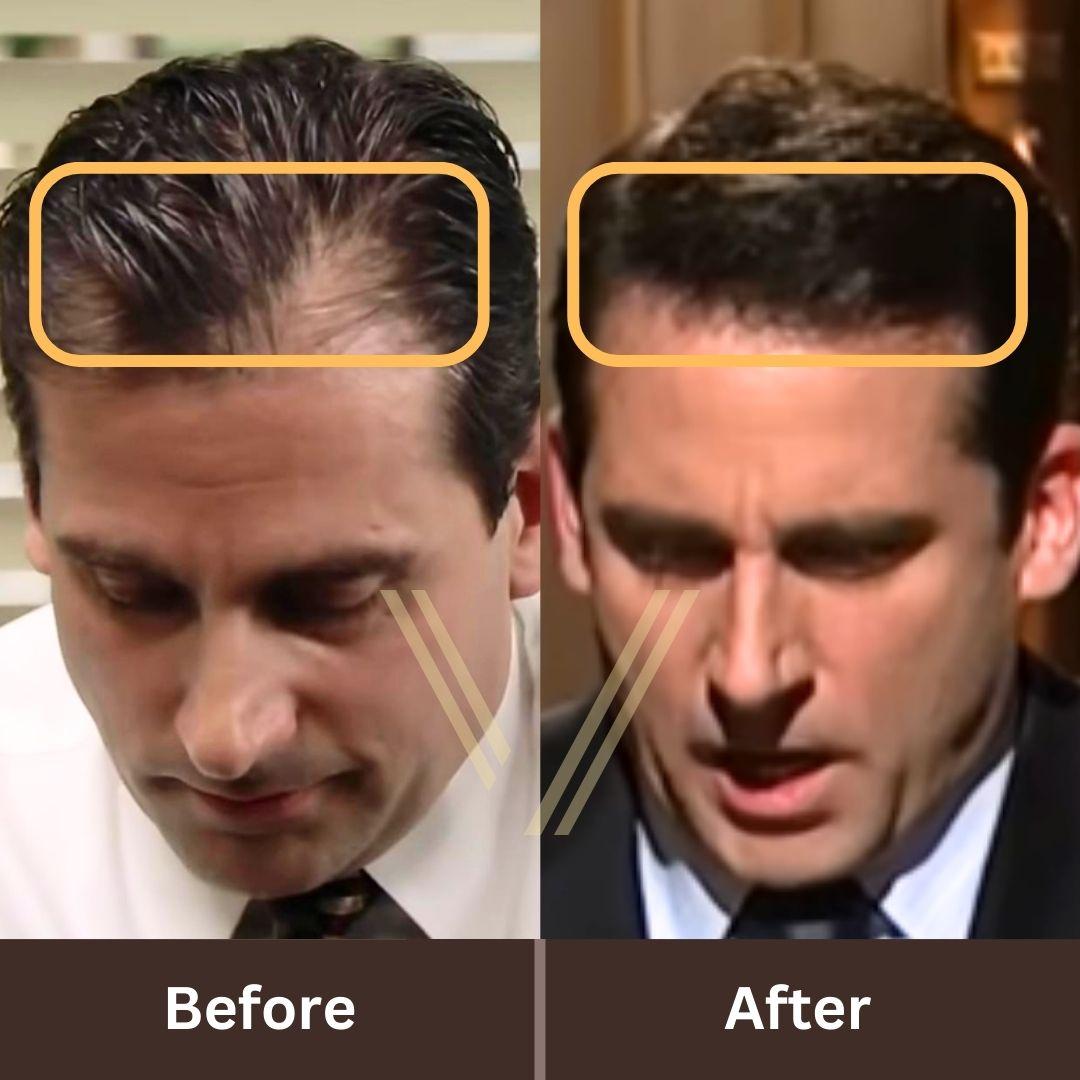
When discussing hair restoration success stories in the public eye, few names spark as much curiosity and admiration as Steve Carell. As a hair transplant specialist with years of clinical experience observing both surgical outcomes and natural hair loss patterns, I find his transformation particularly compelling—not just from an aesthetic standpoint, but from a technical and strategic one as well.
This review will explore his hair evolution, assess the likelihood of intervention, and break down what makes his case so relevant for men considering hair restoration today.
Early Signs of Hair Loss
In the early stages of his career—particularly during his time on The Daily Show in the late 1990s—Carell exhibited clear signs of androgenetic alopecia, commonly known as male pattern baldness. From a clinical perspective, his hairline showed early recession at the temples, forming what we classify as a Norwood 2 to Norwood 3 pattern.
At that stage, the thinning was subtle but progressive. The frontal hairline had begun to lose density, and the temples were visibly retreating. This is a textbook presentation for men in their late 20s to early 30s who are genetically predisposed to hair loss.
Importantly, there was no indication of diffuse thinning across the crown at that time—suggesting a frontal-dominant pattern, which often responds well to targeted hair restoration procedures.
The Transformation Phase
The most noticeable shift in Carell’s hair occurred between the early seasons of The Office and later appearances. Viewers quickly picked up on the dramatic improvement: a fuller, denser hairline with significantly reduced recession.
From a professional standpoint, this change did not occur naturally.
Hair loss, especially when left untreated, does not reverse itself to this degree. While medications like finasteride and minoxidil can slow or partially improve thinning, they do not typically recreate a youthful hairline with such density and symmetry.
This leads to a strong and widely accepted conclusion within the hair restoration community: Steve Carell likely underwent a hair transplant procedure.
Type of Hair Transplant Likely Performed
Based on visual analysis, Carell’s results are most consistent with a Follicular Unit Transplantation (FUT) or early Follicular Unit Extraction (FUE) procedure.
Why FUT is Likely
During the time his transformation occurred (mid-2000s), FUT was the dominant method used by top surgeons. This technique involves removing a strip of scalp from the donor area (typically the back of the head), dissecting it into individual follicular units, and implanting them into the thinning regions.
The density achieved in Carell’s frontal hairline suggests a high graft yield—something FUT excels at.
Why FUE Cannot Be Ruled Out
While less common at the time, early FUE procedures were emerging. If performed by a skilled surgeon, FUE could also produce natural-looking results, although typically with slightly less density per session compared to FUT during that era.
Hairline Design: A Key Factor in Natural Results
One of the most impressive aspects of Carell’s transformation is the design of his hairline.
A poorly executed transplant often results in a straight, unnatural hairline that immediately signals surgical intervention. In contrast, Carell’s hairline appears:
- Age-appropriate
- Slightly irregular (mimicking natural growth patterns)
- Soft at the frontal edge with gradual density build-up
This indicates a highly skilled surgeon who understood not just graft placement, but also facial proportions and long-term aging.
From an expert perspective, this is where many procedures fail—not in graft survival, but in artistic execution.
Density and Graft Placement
Carell’s current hair density suggests a transplant of approximately 2,000 to 3,000 grafts, focused primarily on:
- Frontal hairline
- Temporal regions
- Frontal mid-scalp
The density appears consistent with strategic packing rather than excessive grafting. This is crucial, as overpacking can damage existing follicles and compromise blood supply.
Instead, his result shows:
- Even distribution
- Strong frontal framing
- Natural transition into native hair
This is a hallmark of conservative, well-planned restoration.
Donor Area Management
Another critical aspect often overlooked in celebrity transformations is the donor area.
In Carell’s case, there are no visible signs of overharvesting. The back and sides of his scalp maintain a uniform density, suggesting:
- Careful extraction or strip removal
- Proper closure techniques (if FUT was used)
- Long-term planning to preserve donor reserves
This is essential because hair loss is progressive. A good surgeon must plan not just for the present, but for how the patient will look 10–20 years later.
Has He Used Medication?
While a transplant can restore lost hair, it does not stop ongoing hair loss.
Given the stability of Carell’s hair over the years, it is highly likely that he supplemented his procedure with medical therapy, such as:
- Finasteride (to reduce DHT levels)
- Minoxidil (to support hair growth and thickness)
This combination is standard in modern hair restoration protocols and plays a significant role in maintaining results.
Public Perception vs Clinical Reality
Interestingly, Steve Carell has never publicly confirmed undergoing a hair transplant. However, within professional circles, his transformation is often cited as one of the most successful and natural-looking examples in Hollywood.
The reason it resonates so strongly is simple: it doesn’t look “done.”
There are no abrupt changes, no unnatural density spikes, and no obvious surgical markers. Instead, the result blends seamlessly with his overall appearance—enhancing rather than redefining his look.
Why His Case Matters
From a patient education standpoint, Carell’s hair journey offers several key lessons:
1. Timing Is Crucial
He appears to have addressed hair loss early, before extensive thinning occurred. This allows for better outcomes and more natural integration.
2. Conservative Design Wins
Rather than chasing a teenage hairline, the approach was age-appropriate. This ensures longevity and realism.
3. Skill Over Quantity
The success lies not in the number of grafts, but in their placement and design.
4. Maintenance Is Essential
Long-term stability suggests ongoing care, likely through medication.
Comparison With Typical Results
In everyday clinical practice, not all patients achieve outcomes like Carell’s—and this is important to acknowledge.
Factors that influence results include:
- Donor hair quality
- Extent of hair loss
- Scalp laxity (for FUT)
- Surgeon experience
- Post-operative care
Carell likely had favourable characteristics, including strong donor density and a predictable hair loss pattern, which contributed to his excellent outcome.
Modern Perspective: Would His Procedure Be Different Today?
If Steve Carell were to undergo his procedure today, there are a few advancements that might influence the approach:
- Refined FUE techniques with higher graft survival
- Sapphire blades for more precise incisions
- Robotic assistance for extraction
- Improved anaesthesia and recovery protocols
However, the core principles—natural design, strategic density, and long-term planning—remain unchanged.
His result still holds up against modern standards, which is a testament to the quality of the original work.
Final Assessment
From a professional standpoint, Steve Carell’s hair transformation is an outstanding example of successful hair restoration.
It demonstrates:
- Excellent surgical technique
- Thoughtful hairline design
- Effective long-term management
- Natural, undetectable results
In fact, it represents what most patients aim for: improvement without obvious intervention.
Conclusion
For anyone considering a hair transplant, the case of Steve Carell provides both inspiration and a realistic benchmark.
It shows that with the right approach—combining surgical expertise, medical support, and careful planning—hair restoration can deliver results that are not only effective but also completely natural.
As a specialist, I often reference his transformation when discussing expectations with patients. Not because every case will look identical, but because it perfectly illustrates what is possible when all elements of hair restoration are executed correctly.
In a field where subtlety defines success, Steve Carell stands as one of the finest examples of how to do it right.