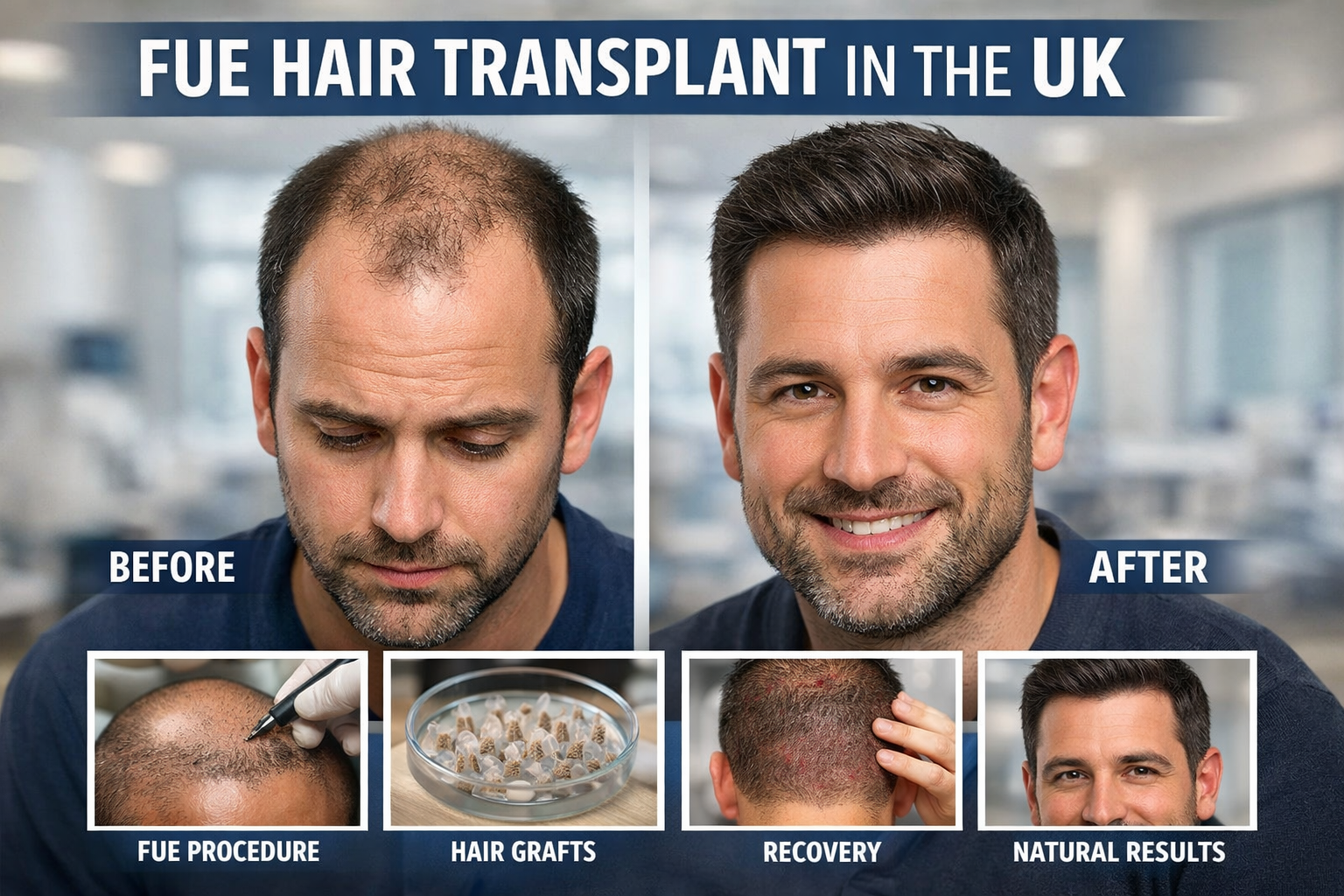
Hair loss can feel deeply personal. For many men and women in the UK, thinning hair or a receding hairline affects confidence, professional image, and overall wellbeing. Over the past decade, one solution has consistently stood out for delivering natural and permanent results with minimal scarring: FUE hair transplant.
As a hair transplant specialist working with international patients, including many from the UK who travel to our clinic in Budapest, Hungary, I have seen first-hand how Follicular Unit Extraction (FUE) has transformed modern hair restoration. This review explains the procedure in depth, from consultation to final results, and offers honest insight into what UK patients can realistically expect when choosing FUE in Budapest.
What Is FUE Hair Transplant?
FUE stands for Follicular Unit Extraction. It is a minimally invasive hair transplant technique where individual hair follicles are extracted directly from the donor area, usually the back and sides of the scalp, and implanted into thinning or bald regions.
Each follicular unit naturally contains between one and four hairs. These units are carefully removed using a micro-punch tool, typically less than 1 millimetre in diameter. The grafts are then implanted into precisely created recipient sites that replicate natural hair growth angles and direction.
Unlike traditional strip surgery, FUE does not involve removing a section of scalp. This eliminates a linear scar and significantly reduces recovery time.
Why UK Patients Travel to Budapest for FUE
Budapest has become a recognised centre for high-quality medical procedures, including hair transplantation. Many UK patients choose treatment in Hungary for several reasons:
-
Experienced surgeons performing high volumes of FUE procedures
-
Modern, well-equipped clinics
-
Transparent pricing
-
Significant cost savings compared to many UK clinics
-
Short flight time from the UK
-
Personalised patient care
At our Budapest clinic, we regularly welcome patients from London, Manchester, Birmingham, and other major UK cities. Travel is straightforward, and most patients combine treatment with a short recovery stay.
Understanding Hair Loss Before Surgery
Before discussing the procedure itself, it is important to understand hair loss patterns.
The most common cause in men is androgenetic alopecia, also known as male pattern baldness. In women, thinning tends to be more diffuse. Hair loss is progressive. That means any surgical plan must consider not only current hair density but future changes.
A successful FUE hair transplant is never just about filling bald areas. It is about long-term planning, donor preservation, and creating a natural result that still looks appropriate years later.
The Consultation Process
Every FUE journey begins with a detailed consultation. For UK patients, this can be conducted online initially, followed by an in-person assessment in Budapest before surgery.
During consultation, we evaluate:
-
Extent and pattern of hair loss
-
Donor area density and quality
-
Hair thickness and texture
-
Scalp condition
-
Medical history
-
Family history of hair loss
-
Patient expectations
We calculate the estimated graft requirement and design a personalised hairline. This is one of the most critical aspects of the entire process.
Hairline Design: Where Medicine Meets Art
A natural hairline is not straight, sharp, or artificially dense. It must suit facial proportions, age, and future hair loss progression.
Key principles of natural hairline design include:
-
Soft irregularity rather than geometric symmetry
-
Use of single-hair grafts at the front
-
Gradual density increase behind the hairline
-
Appropriate height for the patient’s age
Overly aggressive, low hairlines may look appealing at age 30 but can appear unnatural at age 45. Ethical surgical planning is essential.
The FUE Procedure Step by Step
1. Preparation
On the day of surgery:
-
The donor area is trimmed short
-
The scalp is cleansed
-
Local anaesthetic is administered
Patients remain awake throughout the procedure. Discomfort is minimal.
2. Follicular Unit Extraction
Using a micro-punch device, individual follicular units are carefully extracted from the donor area. Precision is critical. Overharvesting can cause visible thinning at the back of the scalp.
An experienced surgeon ensures:
-
Even distribution of extractions
-
Minimal trauma to follicles
-
Preservation of donor density
-
High graft survival rate
Depending on the case, between 1,500 and 4,000 grafts may be extracted in one session.
3. Graft Handling and Storage
Once extracted, grafts are carefully examined and stored in a temperature-controlled solution. Time outside the body must be minimised to preserve viability.
Graft handling is a major factor in long-term success.
4. Recipient Site Creation
Tiny incisions are made in the thinning area. The angle, direction, and depth of each incision determine how natural the result will look.
Proper angulation ensures:
-
Natural hair growth pattern
-
Seamless blending with existing hair
-
Avoidance of unnatural “plug” appearance
5. Implantation
Each graft is delicately placed into its designated site. The process is meticulous and may take several hours.
A typical FUE session lasts between 6 and 10 hours, depending on graft numbers.
Does FUE Hurt?
The procedure itself is painless due to local anaesthesia. Patients typically report:
-
Mild discomfort during anaesthetic injections
-
Slight tightness after surgery
-
Minor tenderness for a few days
Most patients do not require strong pain medication.
Recovery After FUE Hair Transplant
Recovery is usually straightforward and predictable.
First 3 Days
-
Mild swelling
-
Redness in recipient area
-
Small scabs around grafts
Sleeping with the head elevated reduces swelling.
Days 7 to 10
-
Scabs fall off naturally
-
Donor area healing improves
-
Most visible signs diminish
Weeks 2 to 4
Transplanted hairs shed. This is normal and expected. The follicles remain alive under the skin.
Months 3 to 4
New hair growth begins.
Months 6 to 9
Noticeable density develops.
12 Months
Final results are visible for hairline and mid-scalp work. Crown areas may take up to 15 months.
What Results Can You Expect?
FUE does not create new hair. It redistributes genetically resistant follicles.
Realistic outcomes include:
-
Natural-looking hairline
-
Improved density
-
Permanent transplanted hair
-
Gradual thickening over one year
Transplanted hair behaves like donor hair. It can be cut, styled, and shaved normally.
Graft Survival Rate
With proper technique, graft survival rates range between 90 and 95 percent.
Factors influencing survival include:
-
Surgical precision
-
Graft handling
-
Patient adherence to aftercare
-
Smoking habits
-
General health
High survival rates are achieved through meticulous technique and controlled surgical environments.
Advantages of FUE Hair Transplant
FUE offers several significant benefits:
Minimal Scarring
Tiny dot scars are virtually undetectable, even with short haircuts.
Faster Recovery
No stitches are required, reducing downtime.
Natural Results
Precise placement creates seamless hair growth patterns.
Suitable for Short Hairstyles
Patients can wear hair very short without visible scarring.
Versatility
FUE can be used for scalp, beard, and eyebrow transplants.
Potential Risks and Complications
Although FUE is considered safe, every surgical procedure carries some risk.
Possible complications include:
-
Temporary swelling
-
Redness
-
Numbness
-
Shock loss of surrounding hair
-
Infection (rare)
-
Uneven density if poorly executed
Choosing a qualified and experienced clinic significantly reduces risk.
FUE vs FUT
Some patients ask about the difference between FUE and strip surgery (FUT).
FUE:
-
Individual follicle extraction
-
No linear scar
-
Faster healing
-
Ideal for short hairstyles
FUT:
-
Strip of scalp removed
-
Linear scar remains
-
Slightly higher graft yield in certain cases
In modern European practice, FUE is generally preferred due to cosmetic advantages.
Cost of FUE Hair Transplant in Budapest
Cost is a major reason UK patients travel to Hungary.
In the UK, FUE can range from £4,000 to £12,000 depending on graft numbers and clinic reputation.
In Budapest, the same level of expertise and medical standards is often available at significantly lower cost, typically between £2,000 and £5,000 depending on graft count.
This price difference is largely due to lower operating costs rather than lower quality.
Travel and Recovery for UK Patients
Budapest is easily accessible from the UK via direct flights.
Most patients:
-
Arrive one day before surgery
-
Stay 2 to 3 nights after
-
Return home within 4 days
Light activities can resume quickly. Intense exercise should be avoided for approximately 2 weeks.
Long-Term Maintenance
While transplanted hair is permanent, native hair may continue thinning.
We may recommend:
-
Finasteride for men
-
Topical minoxidil
-
PRP therapy
-
Regular follow-up
Hair restoration should be viewed as part of a long-term strategy.
FUE for Women
Female hair transplant requires careful assessment.
Women typically:
-
Prefer minimal shaving
-
Experience diffuse thinning
-
Require density improvement rather than full reconstruction
FUE can be adapted to suit these needs.
Common Myths About FUE
Myth: Results are immediate.
Reality: Full results take up to 12 months.
Myth: FUE leaves no scars.
Reality: Scarring is minimal but not zero.
Myth: It prevents future hair loss.
Reality: It does not stop progression of native hair thinning.
Myth: Anyone can perform it.
Reality: It requires medical training and surgical expertise.
The Importance of Surgeon Experience
FUE is technique-sensitive. Poor execution can lead to:
-
Overharvested donor area
-
Artificial hairline
-
Low graft survival
-
Patchy results
When choosing a clinic in Budapest, UK patients should look for:
-
Verified patient results
-
Clear medical consultation
-
Transparent pricing
-
Realistic expectations
Skill and planning determine the outcome.
Final Expert Opinion
FUE hair transplant represents one of the most advanced and refined solutions for hair restoration available today. For UK patients willing to travel to Budapest, it offers a combination of medical expertise, affordability, and personalised care.
When performed correctly, FUE provides:
-
Permanent results
-
Natural hairlines
-
Minimal scarring
-
High graft survival
-
Predictable recovery
It is not a quick cosmetic fix. It is a carefully planned medical procedure that requires precision, experience, and long-term vision.
For suitable candidates, FUE can restore not just hair density, but confidence and self-image for years to come.