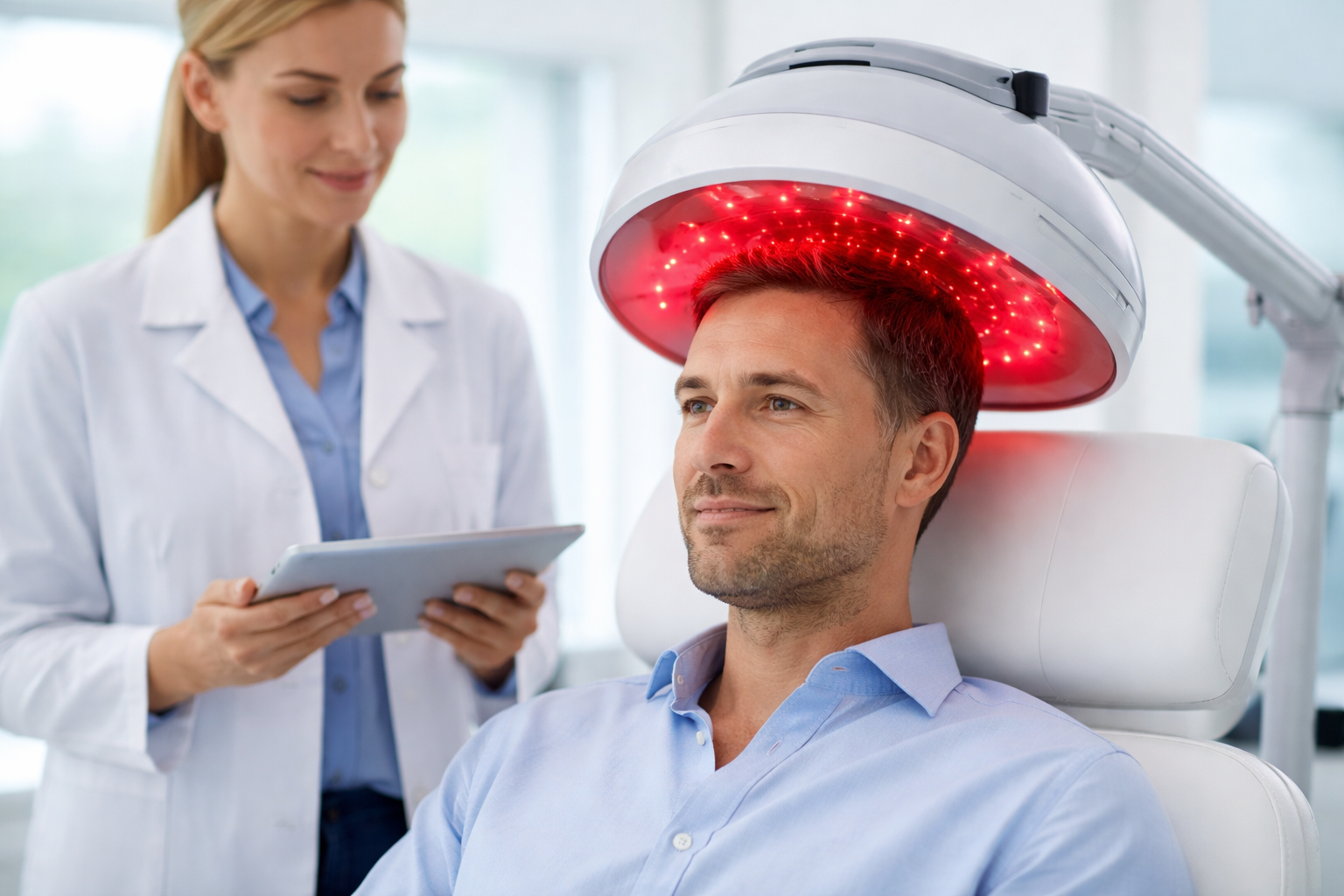
Hair loss patients in the UK are increasingly looking beyond domestic clinics and exploring treatment options across Europe. One destination that frequently comes up in consultations is Budapest, Hungary. Known for its medical tourism industry, Budapest has become a hub for dental work, cosmetic procedures, and increasingly, hair restoration treatments — including laser therapy.
As a hair transplant specialist working primarily with UK patients, I am often asked whether travelling to Budapest for laser hair therapy is worthwhile, safe, and effective. This detailed review explores laser therapy in Budapest from a clinical, practical, and patient-focused perspective. It covers how the treatment works, the standards of care, costs, expected results, and whether it is a sensible option for UK-based individuals experiencing hair thinning.
Understanding Laser Therapy for Hair Loss
Laser therapy for hair loss, also known as Low-Level Laser Therapy (LLLT), uses red light wavelengths to stimulate hair follicles. The light energy penetrates the scalp and supports cellular activity within the follicle. Unlike surgical lasers, this treatment does not cut or damage tissue. It is non-invasive and painless.
In clinical practice, LLLT is used for:
-
Male pattern baldness
-
Female pattern hair loss
-
Diffuse thinning
-
Supporting hair transplant recovery
-
Slowing early-stage shedding
The therapy works through photobiomodulation. Red light stimulates mitochondria inside follicle cells, increasing ATP production. This improves follicle metabolism and may prolong the growth phase (anagen phase) of the hair cycle.
It is important to understand that laser therapy does not create new hair follicles. It can only stimulate follicles that are still viable but weakened.
Why Budapest Has Become a Hair Restoration Destination
Budapest has developed a strong reputation in medical tourism. The city attracts thousands of international patients every year due to:
-
Lower treatment costs compared to the UK
-
Modern private clinics
-
English-speaking medical staff
-
Short flight times from London and other UK cities
-
Well-established cosmetic surgery infrastructure
Hungary has invested heavily in private healthcare facilities over the past two decades. Many clinics in Budapest operate at a high standard and are equipped with modern devices comparable to those used in Western Europe.
For laser therapy specifically, Budapest clinics often combine LLLT with PRP (Platelet-Rich Plasma) or hair transplant procedures, offering package-style treatment plans aimed at international patients.
What to Expect from Laser Therapy Clinics in Budapest
Most reputable clinics in Budapest offering laser hair treatment provide:
-
Consultation with a medical doctor
-
Scalp assessment
-
Trichoscopy (magnified scalp imaging)
-
A treatment plan tailored to hair loss stage
-
In-clinic LLLT sessions
Treatment devices typically involve overhead laser hoods or helmet-style systems. Sessions last between 20 and 30 minutes.
Patients are usually advised to attend multiple sessions per week for several months. Some clinics also sell at-home laser caps as part of a long-term maintenance plan.
From my professional observation, Budapest clinics often operate efficiently and with a strong focus on patient experience. However, standards can vary significantly between providers. Due diligence is essential.
Cost of Laser Therapy in Budapest Compared to the UK
One of the main drivers for UK patients travelling to Hungary is cost.
In the UK, laser therapy sessions typically range between £50 and £150 per session, depending on location and clinic reputation. Home-use laser caps can cost £400 to £1,500.
In Budapest, prices are often 20–40% lower than UK equivalents. Clinics may offer bundled packages, such as:
-
10-session laser therapy courses
-
Combined PRP and LLLT packages
-
Post-transplant recovery protocols
While the upfront session cost may be lower, UK patients should consider:
-
Travel expenses
-
Accommodation
-
Time off work
-
Follow-up logistics
Laser therapy requires ongoing treatment. Travelling repeatedly for maintenance sessions may not be practical. For this reason, Budapest laser therapy makes more sense when combined with another procedure, such as a hair transplant.
Clinical Effectiveness of Laser Therapy
The effectiveness of LLLT does not change based on geographic location. Whether performed in London or Budapest, the biological mechanism remains the same.
Clinical studies show that low-level laser therapy can:
-
Increase hair density in mild to moderate androgenetic alopecia
-
Improve hair shaft thickness
-
Reduce shedding
-
Support existing follicles
Most patients who respond well see:
-
Reduced shedding within 2–3 months
-
Improved density at 4–6 months
-
Maximum visible improvement at 9–12 months
However, results are modest. Laser therapy will not restore a receded hairline or fill completely bald areas.
Patients travelling to Budapest must be cautious of exaggerated marketing claims. No reputable clinic should promise dramatic regrowth from LLLT alone.
Combining Laser Therapy with Hair Transplant Surgery in Budapest
Budapest is particularly well known for hair transplant surgery, especially FUE (Follicular Unit Extraction). Many clinics integrate laser therapy into post-operative recovery plans.
In this context, LLLT may:
-
Reduce inflammation after transplant
-
Improve healing speed
-
Support graft survival
-
Strengthen surrounding native hair
For UK patients already travelling to Budapest for a transplant, adding laser therapy can be convenient and cost-effective.
However, laser therapy alone rarely justifies international travel unless bundled with additional treatments.
Safety and Regulation in Hungary
Hungary is part of the European Union, and medical clinics are subject to EU healthcare standards. Many private clinics in Budapest are modern and well-regulated.
Laser therapy is considered low-risk, with minimal side effects. Common minor reactions include:
-
Mild scalp warmth
-
Temporary redness
-
Slight early shedding
It does not alter hormone levels and is suitable for both men and women.
Nevertheless, patients should verify:
-
Medical credentials of the practitioner
-
CE certification of devices
-
Clinic accreditation
-
Clear treatment documentation
Before travelling, always request a written treatment plan and full cost breakdown.
Who Is a Good Candidate for Laser Therapy in Budapest?
Laser therapy is most suitable for:
-
Early-stage male pattern baldness
-
Female diffuse thinning
-
Patients under 50 with active follicles
-
Those seeking maintenance after transplant
-
Individuals intolerant to oral medications
It is less effective for:
-
Advanced Norwood 6 or 7 hair loss
-
Completely bald crowns
-
Scarring alopecia
-
Long-standing dormant follicles
Patients often overestimate what laser therapy can achieve. A realistic medical consultation is essential before committing to travel.
Female Patients Travelling to Budapest
Female hair loss patients frequently seek non-surgical options. Laser therapy appeals to women because it:
-
Is non-hormonal
-
Is painless
-
Has minimal side effects
-
Requires no downtime
Budapest clinics commonly treat female pattern hair loss and may combine LLLT with PRP for improved outcomes.
For UK-based women, the decision often depends on whether they are already travelling for other procedures. Standalone laser therapy abroad is rarely necessary.
Practical Considerations for UK Patients
When advising UK patients about travelling to Budapest for laser hair treatment, I discuss several practical factors:
-
Follow-up care
Laser therapy requires continuity. Can the clinic coordinate follow-up remotely? -
Travel frequency
Will multiple trips be required? -
Language clarity
Are consultations conducted clearly in English? -
Aftercare support
Is there structured monitoring of progress? -
Device quality
What specific laser technology is being used?
Budapest has excellent clinics, but patients must distinguish between marketing-driven centres and medically led facilities.
Psychological Expectations and Medical Tourism
Medical tourism often creates heightened expectations. Patients travel abroad hoping for dramatic improvement at lower cost.
Laser therapy, however, is subtle. It improves hair quality gradually. The transformation is usually incremental, not dramatic.
Patients should understand:
-
Hair loss is progressive
-
Laser therapy slows, not reverses, advanced loss
-
Maintenance is lifelong
Travel should not create unrealistic hope. Clear education before booking is critical.
Advantages of Choosing Budapest
For UK patients already considering hair transplant surgery in Hungary, adding laser therapy may offer:
-
Cost efficiency
-
Integrated care
-
Access to modern facilities
-
Structured treatment packages
Budapest clinics often provide comprehensive aesthetic services under one roof. This can be convenient for international patients.
Limitations of Travelling for Laser Therapy Alone
From a specialist perspective, I do not typically recommend international travel solely for laser therapy unless:
-
It is combined with another procedure
-
There is a specific clinic with proven reputation
-
The patient plans to purchase an at-home device for maintenance
Since LLLT requires ongoing use, local access to treatment is usually more practical.
My Professional Verdict
Laser therapy for hair loss in Budapest can be safe, legitimate, and reasonably priced when performed by reputable clinics.
The biological effectiveness of LLLT is consistent regardless of location. Budapest does not offer a superior version of laser therapy, but it may offer it at a lower price.
For UK patients:
-
If travelling for a hair transplant, adding LLLT may be worthwhile.
-
If seeking standalone laser therapy, local UK options are often more practical.
-
Results are gradual and modest.
Laser therapy is best viewed as a supportive treatment. It strengthens miniaturised follicles, improves thickness, and slows progression. It does not replace surgical restoration for advanced hair loss.
Frequently Asked Questions
Is laser therapy in Budapest safe?
Yes, when performed in accredited clinics with CE-certified devices.
Will I need multiple trips?
Possibly, unless you purchase a home-use device.
Is it cheaper than the UK?
Often yes, but travel costs must be considered.
Does it work for bald areas?
Only if follicles are still active.
Can it replace a hair transplant?
No, it cannot recreate lost follicles.
Final Thoughts
Budapest has earned its reputation as a medical tourism centre. Laser therapy for hair loss is widely available and often competitively priced. However, the success of treatment depends more on correct diagnosis, patient selection, and realistic expectations than geographic location.
Laser therapy is a scientifically supported, low-risk treatment for early hair thinning. It is best used as part of a comprehensive hair restoration strategy, not as a standalone miracle solution.
UK patients considering Budapest should prioritise medical credibility over price and ensure continuity of care before making travel decisions.
Hair restoration is a long-term journey. The right treatment plan — whether in London or Budapest — should always be personalised, medically sound, and aligned with realistic outcomes.