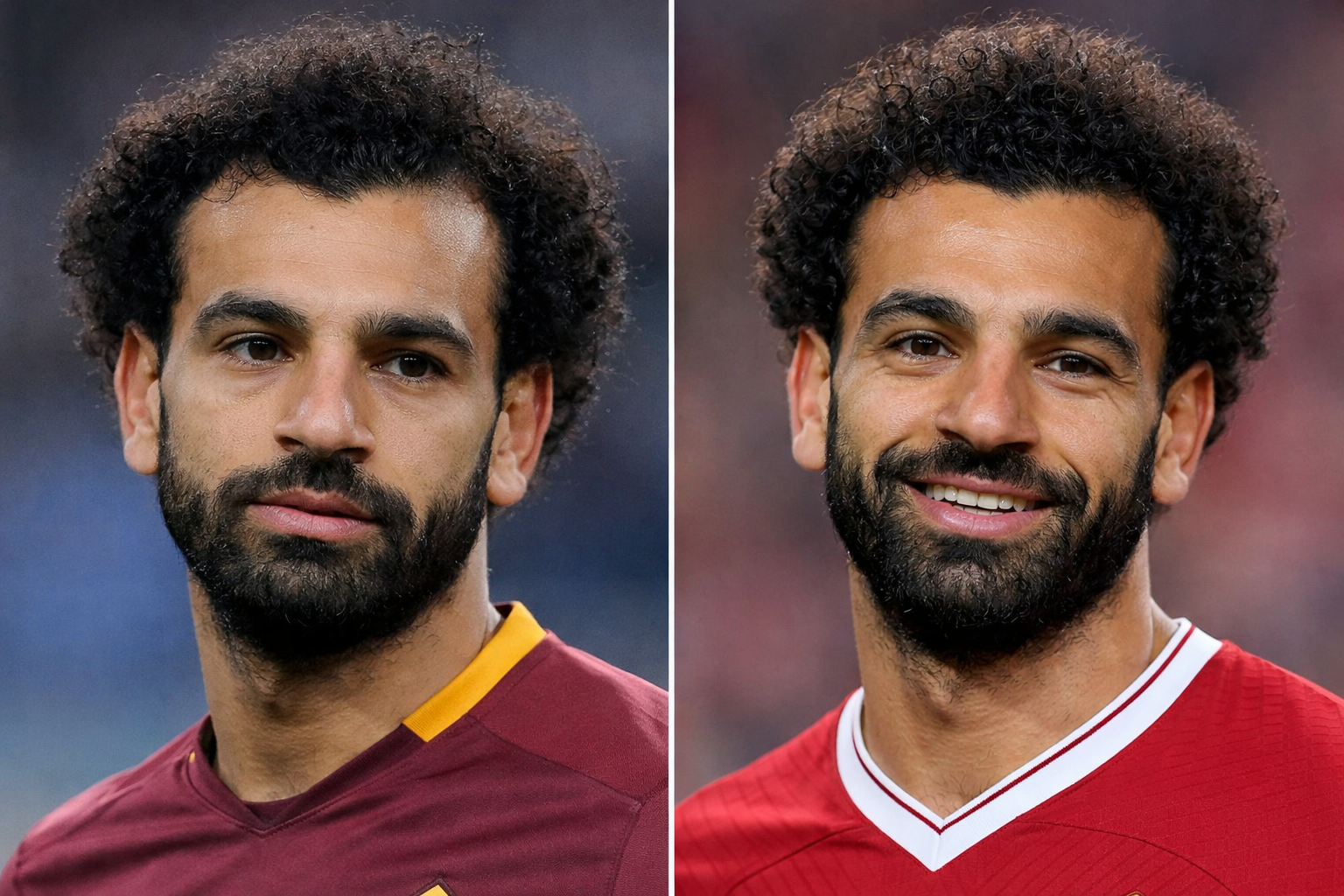
Mohamed Salah, one of football’s most recognizable stars, has not only made headlines for his performances on the pitch but also for his noticeable hair transformation over the years. As a hair transplant specialist, I’ve followed his journey closely, and his case provides a compelling example of modern hair restoration done right.
In this in-depth review, I will break down Mohamed Salah’s hair evolution, assess the likely techniques used, and explain why his results are considered highly successful from a clinical and aesthetic standpoint.
Early Signs of Hair Loss
When Salah first emerged in European football during his time at FC Basel and later Chelsea, his hair appeared dense, particularly in the crown and mid-scalp areas. However, even in those early years, there were subtle indicators of a receding hairline—especially around the temples.
By the time he moved to AS Roma, the recession had become more pronounced. His hairline began forming a classic “M-shape,” a hallmark of male pattern baldness (androgenetic alopecia). This condition is extremely common and affects a significant percentage of men in their 20s and 30s.
In Salah’s case, the progression appeared moderate but noticeable. The temples receded further, and the frontal density began to thin. This stage is often where patients start considering intervention.
The Turning Point: Visible Transformation
The most striking change in Salah’s hair came during his early years at Liverpool. Fans and observers began noticing a fuller, more defined hairline that looked significantly improved compared to previous seasons.
From an expert perspective, this was not a natural reversal. Hair loss of this type does not spontaneously improve. The transformation strongly suggests that Salah underwent a hair transplant procedure.
Key improvements included:
- A lower and more symmetrical hairline
- Increased density in the frontal region
- Better framing of the face
- Consistent thickness across the hairline
These are classic indicators of a well-executed hair transplant.
Likely Technique Used
Based on the visual evidence and the natural appearance of the results, it is highly likely that Salah underwent an FUE (Follicular Unit Extraction) procedure.
Why FUE?
FUE is the preferred technique among athletes and public figures for several reasons:
- Minimal scarring: No linear scar, making it ideal for short hairstyles
- Faster recovery: Crucial for someone with a demanding schedule
- Natural results: Allows precise placement of grafts
In Salah’s case, the hairline design appears soft and irregular in a natural way, which is a hallmark of advanced FUE work.
Hairline Design: The Most Important Factor
One of the most impressive aspects of Salah’s transformation is the hairline design. This is where many clinics fail, but in his case, it appears expertly planned.
Characteristics of His Hairline
- Age-appropriate: Not too low or artificially straight
- Slight irregularity: Mimics natural hair growth patterns
- Temple reconstruction: Subtle but effective
A poorly designed hairline can look unnatural and draw attention. Salah’s hairline, however, blends seamlessly with his facial features and ethnicity, which is critical for authenticity.
Graft Estimation
While exact numbers are not publicly available, we can estimate the number of grafts used based on the visible coverage.
Estimated Graft Count
- Frontal hairline: 1,200–1,500 grafts
- Temples and reinforcement: 500–800 grafts
Total estimated grafts: 1,800–2,300
This is a moderate-sized procedure, typical for someone in the early to mid stages of hair loss.
Density and Natural Appearance
Density is where many transplants fall short. Overpacking can damage grafts, while underpacking leads to thin results.
Salah’s transplant strikes a balance:
- Natural density in the hairline
- Gradual transition from front to mid-scalp
- No visible “pluggy” effect
This suggests careful graft placement and likely the use of single-hair grafts at the front, transitioning to multi-hair grafts behind.
Donor Area Management
A successful transplant is not just about the front—it’s also about preserving the donor area.
In Salah’s case:
- No visible thinning in the donor region
- Even distribution of extraction points
- Maintained density at the back and sides
This indicates a conservative and strategic approach, which is essential for long-term results.
Timeline of Results
Hair transplant results do not appear overnight. Based on typical growth cycles, Salah’s transformation likely followed this timeline:
- 0–2 weeks: Shedding phase
- 3–4 months: Initial regrowth begins
- 6–8 months: Noticeable improvement
- 12 months: Full results visible
His public appearances suggest a gradual improvement consistent with this timeline.
Styling and Maintenance
Another reason Salah’s transplant looks so natural is how he styles his hair.
He often keeps it:
- Slightly textured
- Naturally curly
- Medium length
This helps enhance the illusion of density and avoids exposing the hairline too aggressively.
Additionally, it’s highly likely that he follows a maintenance routine, which may include:
- Finasteride (to prevent further loss)
- Minoxidil (to support growth)
- PRP therapy (optional enhancement)
Why His Results Stand Out
From a professional standpoint, Salah’s transplant is a textbook example of how to achieve natural-looking results.
Key Success Factors
- Conservative planning
- Skilled surgeon
- Appropriate graft count
- Natural hairline design
- Proper aftercare
Many patients make the mistake of chasing a very low or dense hairline, which can look unnatural. Salah’s approach prioritizes realism over aggression.
Comparison to Other Celebrity Transplants
While many celebrities undergo hair transplants, not all achieve the same level of success.
Common issues seen in less successful cases include:
- Straight, unnatural hairlines
- Excessive density in the front
- Visible scarring
- Poor graft survival
Salah avoids all of these pitfalls. His results are subtle enough that casual observers may not even realise he had a procedure.
Suitability for Similar Patients
Salah’s case is ideal for patients who:
- Are in early to mid stages of hair loss
- Have strong donor areas
- Want natural, undetectable results
However, it’s important to understand that not everyone is a suitable candidate. Factors such as donor density, hair type, and progression of hair loss must be assessed individually.
Lessons for Patients in the UK
For those considering a hair transplant in the UK, Salah’s case offers several important lessons:
1. Choose Quality Over Cost
Cheap procedures often lead to poor outcomes. Investing in a reputable clinic is crucial.
2. Avoid Overpromising Clinics
Be wary of clinics that promise extremely dense or low hairlines.
3. Focus on Long-Term Planning
Hair loss is progressive. A good surgeon plans for future loss, not just immediate results.
4. Research the Surgeon
Look for:
- Before-and-after results
- Patient reviews
- Experience with similar hair types
Psychological Impact
Hair restoration is not just cosmetic—it has a significant psychological effect.
A restored hairline can:
- Improve confidence
- Enhance public image
- Reduce anxiety related to appearance
For a global figure like Salah, maintaining a strong visual presence is part of his brand. His transformation likely contributed positively to his overall confidence.
Final Expert Verdict
From a clinical and aesthetic perspective, Mohamed Salah’s hair transplant is a clear success.
Overall Rating: 9/10
Strengths:
- Natural hairline design
- Excellent density balance
- No visible scarring
- Age-appropriate results
Minor Considerations:
- Slight conservatism in temple reconstruction (though this may be intentional)
Conclusion
Mohamed Salah’s hair transplant is a prime example of how modern hair restoration can deliver subtle, natural, and highly effective results. His transformation demonstrates the importance of expert planning, skilled execution, and realistic expectations.
For anyone considering a hair transplant, his case serves as a benchmark. The goal should not be perfection, but authenticity—and Salah achieves that exceptionally well.
If approached correctly, a hair transplant can be life-changing. Salah’s journey proves that when done right, the results can be virtually undetectable and entirely transformative.