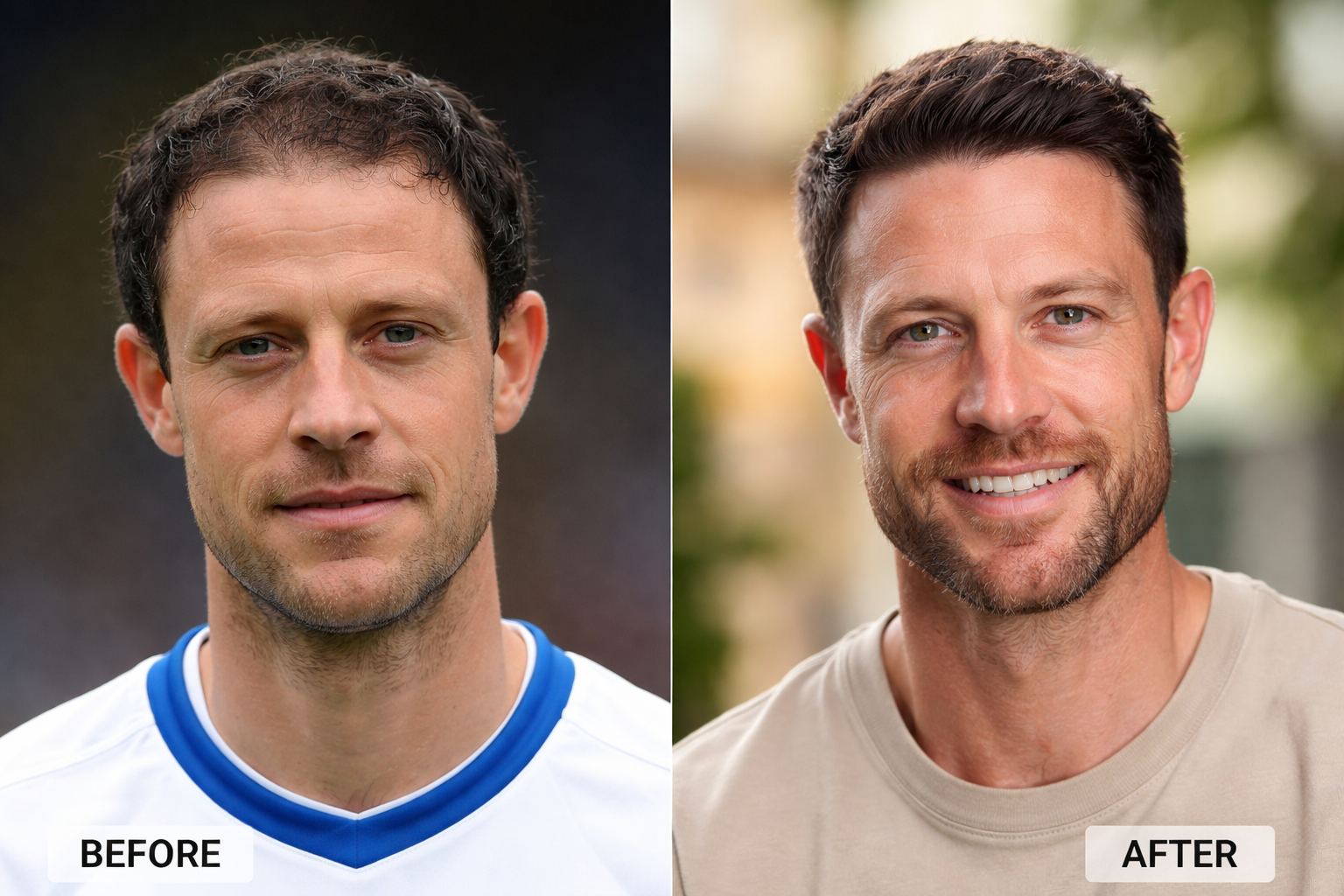
Hair loss is a common issue that affects millions of men around the world, including professional athletes and celebrities. One well-known public figure who has openly addressed hair thinning is former England international footballer Wayne Bridge. Over the years, Bridge has undergone hair transplant procedures to restore his hairline and maintain a youthful appearance. His transformation has drawn attention not only from football fans but also from people researching hair restoration options.
In this in-depth review, we will examine Wayne Bridge’s hair transplant journey, the techniques likely used in his procedures, the results he achieved, and what prospective patients can learn from his experience. By analysing his case, we can better understand how modern hair transplantation works and what realistic expectations look like.
Who Is Wayne Bridge?
Wayne Bridge is a former professional footballer who played as a left-back for several top clubs including Southampton, Chelsea, Manchester City, Fulham, and Brighton. He also earned international caps for England during his career.
Bridge was known for his pace, technical ability, and consistency on the pitch. After retiring from professional football, he remained in the public eye through television appearances, punditry, and various media projects.
Like many men, Bridge began experiencing hair thinning relatively early in adulthood. Because of his public profile, the changes in his hairline were visible to fans and the media. Eventually, he decided to pursue hair restoration treatment, leading to a noticeable improvement in his hair density and hairline structure.
Early Signs of Hair Loss
Before undergoing a hair transplant, Wayne Bridge showed classic signs of male pattern baldness. This condition, medically known as androgenetic alopecia, is the most common cause of hair loss in men.
Typical indicators include:
-
Receding temples
-
Thinning at the crown
-
Gradual loss of hair density across the scalp
-
A developing “M-shaped” hairline
Photographs from Bridge’s playing career in the mid-2000s reveal mild recession around the temples. Over time, the hairline appeared to move further back, and overall density became slightly thinner.
These changes are very common for men in their late twenties and early thirties. Genetics, hormones, and age all play a role in the progression of male pattern baldness.
For someone frequently photographed in high definition, hair loss can become particularly noticeable. Many athletes and celebrities therefore choose hair restoration treatments to maintain their appearance.
When Did Wayne Bridge Have His Hair Transplant?
While Bridge has not publicly disclosed every detail of his procedures, most observers believe he underwent at least one hair transplant during the early 2010s.
The most obvious improvements to his hairline appeared several years after his playing career at Chelsea and Manchester City. Later public appearances showed a fuller frontal hairline and improved density.
Hair transplant transformations often take between 9 and 12 months to fully develop, so any visible changes usually indicate that the procedure occurred roughly a year earlier.
Many experts believe Bridge may have had more than one procedure, which is quite common among hair transplant patients. Multiple sessions allow surgeons to refine the hairline and increase density over time.
The Likely Technique Used
Modern hair transplantation is typically performed using one of two methods:
FUT (Follicular Unit Transplantation)
FUT, sometimes called the strip method, involves removing a strip of scalp from the donor area at the back of the head. Hair follicles are then extracted from this strip and implanted into thinning areas.
While FUT can produce strong density, it leaves a linear scar along the donor area.
FUE (Follicular Unit Extraction)
FUE is now the most popular technique, especially among athletes and celebrities. Instead of removing a strip of scalp, individual hair follicles are extracted directly from the donor area.
These follicles are then implanted into areas of hair loss.
FUE offers several advantages:
-
Minimal scarring
-
Faster recovery time
-
Natural-looking results
-
Ability to wear short hairstyles
Based on the appearance of Wayne Bridge’s donor area and the natural density of his restored hairline, it is widely believed that his transplant was performed using the FUE technique.
Estimated Number of Grafts
Hair transplant procedures are often measured in grafts. A graft usually contains one to four hair follicles.
In Wayne Bridge’s case, experts estimate he may have received between 2000 and 3000 grafts across his procedures.
This number would be sufficient to:
-
Rebuild a receding frontal hairline
-
Increase density in the temples
-
Improve overall hairline structure
The exact number depends on factors such as donor hair density, hair thickness, and the extent of hair loss.
For many patients with moderate recession, around 2000–2500 grafts can produce a noticeable improvement.
Analysing Wayne Bridge’s Results
Wayne Bridge’s hair transplant results are generally considered very successful.
Several aspects of his outcome stand out.
Natural Hairline Design
One of the most important elements of any hair transplant is the hairline design. A poorly designed hairline can look artificial or overly straight.
Bridge’s hairline appears natural, with a subtle irregular pattern that mimics natural hair growth. This approach helps avoid the “plugged” look associated with early hair transplant techniques from decades ago.
Good Density
Another positive aspect of his results is the improved density at the front of the scalp.
The frontal hairline is the most visible part of the hair. Surgeons often prioritise this area to create the appearance of a fuller head of hair.
Bridge’s hairline looks thicker and more structured compared to earlier photographs.
Age-Appropriate Appearance
One mistake sometimes seen in hair transplantation is creating a hairline that is too low or too aggressive.
A realistic hairline should match the patient’s age and facial structure. In Wayne Bridge’s case, the hairline appears age-appropriate and balanced.
This suggests that the surgeon took a conservative approach, which usually leads to more natural long-term results.
Recovery and Growth Timeline
Hair transplant recovery follows a predictable timeline for most patients.
Although Bridge has not publicly documented his recovery process, it likely followed the standard pattern.
First Week
Immediately after the procedure, small scabs form around the transplanted follicles. Mild redness and swelling can occur.
Patients are usually advised to avoid strenuous activity during the first few days.
Weeks Two to Four
The transplanted hairs often shed during this phase. This is a normal part of the process known as “shock loss.”
The follicles remain intact beneath the skin and will begin growing new hair in the coming months.
Months Three to Four
New hair growth begins to appear. At first, the hair may be thin and soft.
Months Six to Nine
Density increases significantly during this stage. The hair becomes thicker and blends with the surrounding hair.
Months Nine to Twelve
Final results typically become visible. The hairline looks fuller and more natural.
Why Athletes Often Choose Hair Transplants
Professional athletes are frequently under public scrutiny. Their appearance is captured in photographs, television broadcasts, and social media.
For individuals constantly in the spotlight, hair loss can feel more noticeable.
Hair transplantation offers several advantages for athletes and public figures:
-
Permanent hair restoration
-
Natural results
-
Minimal maintenance
-
Increased confidence
Many footballers have undergone hair transplant procedures, including players from the Premier League and other major leagues.
The improved techniques available today make it easier to achieve subtle, realistic outcomes.
Maintaining Results After a Hair Transplant
A hair transplant restores hair in areas where follicles have been implanted, but it does not stop ongoing hair loss in untreated areas.
Many patients use additional treatments to maintain their results.
Common options include:
Finasteride
Finasteride is a prescription medication that reduces the hormone responsible for male pattern baldness.
It can slow or stop further hair loss in many men.
Minoxidil
Minoxidil is a topical treatment applied directly to the scalp. It can stimulate hair growth and improve density.
PRP Therapy
Platelet-rich plasma (PRP) therapy involves injecting growth factors derived from the patient’s blood into the scalp.
Some clinics use PRP to support hair transplant results and improve hair quality.
While it is not confirmed whether Wayne Bridge uses any of these treatments, many transplant patients combine surgery with medical therapy to protect their long-term results.
Lessons from Wayne Bridge’s Hair Transplant
Bridge’s experience highlights several important points for anyone considering hair restoration.
Choose an Experienced Surgeon
Hair transplantation requires artistic skill and medical expertise. A well-trained surgeon can design a hairline that complements the patient’s facial structure and produces natural results.
Manage Expectations
Hair transplants can significantly improve hair appearance, but they cannot recreate the density of teenage hair.
Realistic expectations are essential for patient satisfaction.
Plan for the Future
Hair loss is progressive for many men. A good surgeon will design a hairline that still looks natural as the patient ages.
This often means avoiding overly low or aggressive hairlines.
Consider Long-Term Maintenance
Medical treatments and lifestyle choices can help protect existing hair and maintain transplant results.
Cost of a Hair Transplant in the UK
Hair transplant costs vary depending on the number of grafts and the clinic performing the procedure.
In the United Kingdom, prices generally range between:
-
£3,000 and £8,000 for moderate procedures
-
£8,000 to £15,000 for larger or premium treatments
Celebrity patients sometimes choose high-end clinics with internationally recognised surgeons, which can increase the price.
However, many reputable clinics offer excellent results across a range of price points.
Final Thoughts
Wayne Bridge’s hair transplant is a strong example of how modern hair restoration can deliver natural and effective results.
His transformation demonstrates several key elements of successful hair transplantation: a carefully designed hairline, appropriate graft placement, and realistic density.
While the exact details of his procedures remain private, the visible improvement in his hairline suggests skilled surgical work and thoughtful planning.
For individuals experiencing hair loss, Bridge’s case highlights the possibilities available with today’s advanced hair transplant techniques. With the right surgeon, proper planning, and realistic expectations, hair restoration can significantly improve both appearance and confidence.
As awareness of hair transplantation continues to grow, more people are exploring this option to address thinning hair and receding hairlines. Wayne Bridge’s journey serves as a relatable example of how effective modern hair restoration can be when performed correctly.